SEND 4.0 represents structural modernization, not incremental revision.

SEND 4.0 Readiness
SEND 4.0 represents structural modernization, not incremental revision.
Many legacy environments treat SEND as an export function. Data are collected in one system, interpreted in another, and then mapped into SEND structures through external tools or custom utilities.
Each layer introduces reconciliation effort and validation burden.
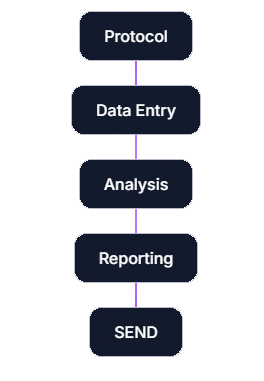
TurboPlatform integrates SEND production within the scientific-operations lifecycle:
Protocol-driven data structure
Controlled terminology mapped at data entry
Traceable data lineage
Integrated reporting environment
Structured SEND package generation
SEND is not a post-processing exercise. It is a natural extension of validated data capture and interpretation.
SEND 4.0 introduces evolution in data structures and expectations. TurboPlatform supports:
Customers maintain ownership of their validation decisions. TurboPlatform provides the framework, documentation support, and architectural consistency required to execute that responsibility efficiently.
SEND 4.0 expands controlled-terminology expectations. In fragmented systems, terminology updates can require:
Database modifications
Interface adjustments
Manual Reconciliation
Repeated validation cycles
Updates occur within one governed framework rather than across disconnected modules.
Modernization does not require abandonment of historical data. TurboPlatform deployment planning includes:
The objective is continuity of regulatory integrity while enabling forward-looking
modernization.
SEND 4.0 will not be the final structural change in regulatory data standards. Future revisions, domain expansions, and international harmonization efforts will continue to evolve expectations.
Regulatory preparedness becomes a continuous capability, not a periodic crisis.
Organizations face a strategic decision:
Maintain layered systems and respond reactively to structural regulatory change

Modernize within a unified, validated architecture designed for evolution
TurboPlatform provides a foundation for controlled modernization aligned with regulatory discipline.